Across Africa and the Middle East, organizations are entering a new regulatory era where audits are continuous, expansive, and increasingly unforgiving. In 2025 alone, organisations in regulated industries spent up to 40% more time preparing for audits compared to three years prior, driven largely by the explosion of data sprawl, shadow systems, and cross-border compliance obligations. The workload has become so demanding that 63% of CISOs now rank audit fatigue among their top five operational risks, ahead of talent shortage and vendor sprawl.
It’s not just volume that’s rising; the cost of failure is increasing as well. Global regulators issued over $7.1 billion in compliance-related penalties in 2023, and financial institutions in emerging markets (particularly in Africa) experienced the steepest year-over-year increase in audit exceptions. Many of these exceptions were not intentional breaches but failures of basic visibility: missing evidence, fragmented spreadsheets, undocumented decisions, and controls scattered across multiple teams.
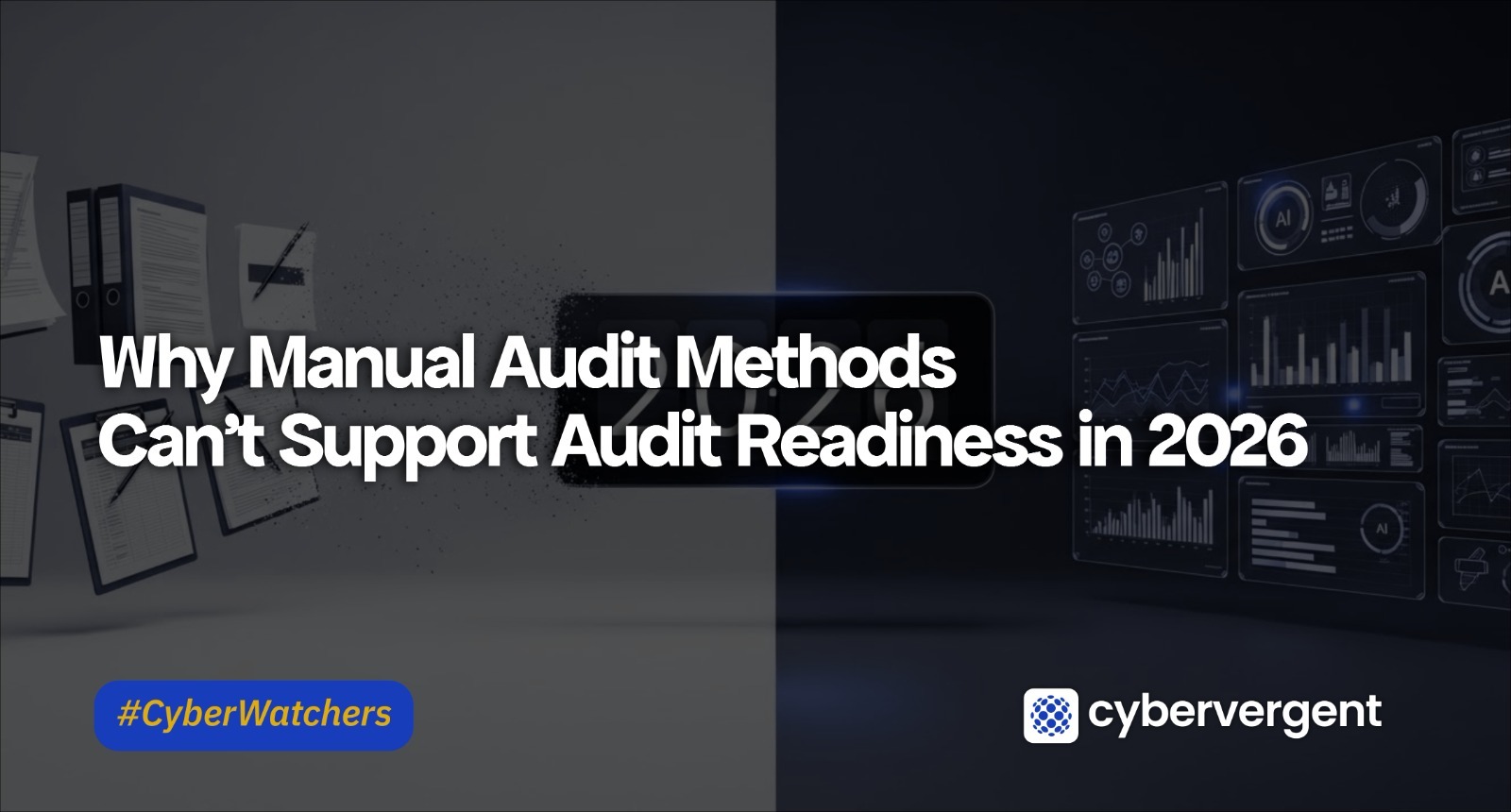
The math is simple but sobering: the number of controls is multiplying, while the traditional audit approach remains frozen in time. This is the audit cliff. And by 2026, organisations relying on manual methods will be structurally unable to keep pace. To stay ready, leaders need systems that can prove control, not just document it—and do so continuously, reliably, and at scale.
Why the audit bar is changing — and fast
Several trends have pushed audit expectations from a paperwork exercise into an operational requirement. First, threat actors are moving faster. Vulnerability exploitation and credential abuse are being weaponised at scale, meaning that the window between compromise and impact is shrinking. Industry analyses show attackers exploiting known vulnerabilities in days while organisations take weeks to patch and sometimes months to remediate exposed secrets. For example, recent DBIR research highlights that the median time to detect some mass exploit events is measured in days, while remediation timelines for leaked secrets can extend to months.
Second, defenders are turning to AI. Security teams increasingly rely on machine learning and automation to manage the volume of telemetry and alerts. Globally, a majority of security professionals see AI as a net positive for detection and response. The Cloud Security Alliance’s State of AI and Security report found that roughly 63% of security practitioners believe AI can improve threat detection and response. (cloudsecurityalliance.org) Yet adoption outpaces governance: leading consultancies warn that most organisations are not adequately prepared to secure an AI-driven future, creating a readiness gap that regulators will scrutinise. Accenture’s 2025 report concluded that a large majority of organisations do not yet have the capabilities or governance to protect against AI-augmented cyber threats.
Third, standards are converging on auditable AI and continuous controls. ISO/IEC 42001 formalises AI management systems and requires organisations to document model purpose, validation and lifecycle controls — the very artifacts auditors will ask for when AI influences detection, prioritisation or remediation. Where ISO/IEC 27001 made information controls auditable, ISO/IEC 42001 does the same for AI-driven controls. (ISO)
Taken together, these factors change the question for executives: it is no longer enough to say “we run scans.” Boards and regulators will ask for demonstrable evidence that controls operate continuously, that AI decisions are governed and recorded, and that remediation targets the assets that matter most to the business.
The operational reality of manual audit methods
Most organisations still prepare for audits the way they always have: named owners compile evidence from multiple sources — SIEM logs, ticketing systems, endpoint consoles and ad-hoc spreadsheets — then stitch a narrative for auditors. This process is labour-intensive and brittle. Spreadsheets go stale within days as cloud instances spin up, employee access changes and third-party services evolve. Manual classification misses shadow data and transient SaaS footprints. Evidence assembly becomes a firefight that consumes skilled teams at the moment they should be focused on preventing the next incident.
The business consequences are tangible. Long Time to Evidence (TTE) prolongs regulatory response windows and increases the cost of audits. Slow Mean Time to Remediate (MTTR) for critical assets leaves material exposure on the balance sheet. Procurement and partners demand proof of control before deals close — and failure to provide evidence can delay or kill revenue opportunities. In short, manual audit methods translate directly into slower operations, greater risk and higher cost.
What modern audit readiness looks like: continuous and evidence-first
The alternative is a posture management model designed from the start for continuous audit readiness. In practice, this means three integrated capabilities operating as a single loop.
Continuous discovery and classification (DSPM) run constantly across cloud, on-prem and SaaS environments, using AI to surface likely PII, misconfigurations and shadow services. Business-aware risk posture (RPM) maps those discoveries to business processes and impact, so teams do not chase low-value alerts but fix what matters to customers and regulators. Compliance posture management (CPM) and workflow orchestration enforce approvals, attestations and time-stamped evidence exports that auditors can consume directly.
The result is operational: a focused set of KPIs and a single source of truth that your auditors, regulators and board can read. Instead of scavenging for logs and emails, your team downloads an auditor pack that includes discovery snapshots, risk scoring rationale and playbook histories — all time-stamped and exportable.
KPIs boards will demand
Translating technical telemetry into board language is essential for executive buy-in. Four concise KPIs cut through the detail and speak to risk and readiness:
- Time to Evidence (TTE): hours to assemble an auditor-ready pack for a control or incident.
- Mean Time to Remediate (MTTR) for critical assets: operational resilience measure.
- TAI freshness: percentage of critical assets with up-to-date classification.
- Automation safety rate: percentage of automated remediations that executed without rollback or adverse impact.
Targets should be realistic but ambitious: TTE measured in hours rather than days; TAI freshness north of 90%; MTTR for critical assets materially reduced quarter-on-quarter.
How a GRC-aware posture platform enables the change
Technology is not a silver bullet, but the right platform materially reduces the effort required to be audit-ready. A GRC-aware posture solution unifies DSPM, RPM and CPM so discovery feeds prioritisation and governance — and every step produces exportable evidence. The platform should include continuous discovery that keeps the Trust Asset Inventory fresh, business-aware scoring so remediation focuses on commercial impact, and workflow orchestration to create approvals, attestations and immutable evidence packs your auditors accept.
When these capabilities are combined, the business outcomes are clear: faster audit responses, demonstrable compliance posture, and reduced operational drag on security and compliance teams. For procurement, the ability to show auditor packs in hours — not weeks — becomes a competitive advantage.
Pitfalls to avoid
Moving to continuous audit readiness is not without risk. Beware of four common errors: relying on superficial “AI” marketing claims without model cards or validation; treating inventory as a once-a-year project; automating remediations without attestation or rollback controls; and accepting vendor black boxes that refuse to disclose performance metrics or retraining logs. Each of these practices undermines audit defensibility and will attract criticism from boards and regulators.
What the data tells us
The evidence supporting this shift is strong. Industry surveys consistently show optimism about AI’s role in security — the Cloud Security Alliance found roughly 63% of practitioners believe AI improves detection and response — while consultancies warn that most organisations lack the governance to secure AI-driven initiatives. Accenture’s recent research highlights that a large majority of organisations are not prepared to defend an AI-augmented future. Regionally, adoption can be very high in leading markets: studies report that over 90% of organisations in the UAE are integrating AI into security strategies. Finally, DBIR analyses show that attackers can exploit vulnerabilities far faster than many organisations patch them, leaving a critical gap that continuous detection and prioritisation can close. (cloudsecurityalliance.org)
Conclusion: move to continuous audit readiness now
Manual audit methods are a rising liability as threats accelerate and regulatory expectations harden. The organisations that will pass the 2026 audit test are those that stop treating inventory and audit evidence as periodic chores and instead operationalise them as continuous controls. That transition requires a GRC-aware posture platform, disciplined governance for AI, and executive sponsorship to change procurement, metrics and accountability. When combined, these elements convert audit readiness from a drain into a differentiator.
If you lead security, compliance or the business in the MEA region and want to see how continuous DSPM, RPM and CPM can deliver auditor-ready evidence in hours, not weeks, Cybervergent can show a practical implementation on your estate. Book a 10–15 minute demo at cybervergent.com/demo.