

Almost every organization has risk registers. Few have true risk visibility.
Enterprise Risk Management (ERM) has evolved well beyond its origins as a governance checkbox. It is now a strategic capability, one that helps leaders make better decisions, allocate resources with precision, and build the kind of resilience that survives more than one audit cycle.
The global ERM market reflects this shift. It is projected to grow from $6 billion in 2025 to nearly $12 billion by 2030, expanding at a 14.8% CAGR. According to MarketsandMarkets, this momentum is mostly driven by cyber risk, cloud expansion, and regulatory pressure.
In this guide, we cover what ERM really covers, why it matters more now than it did years ago, the key benefits it delivers, six strategies that work in practice, and the mistakes that undermine most programs.
What Is Enterprise Risk Management?
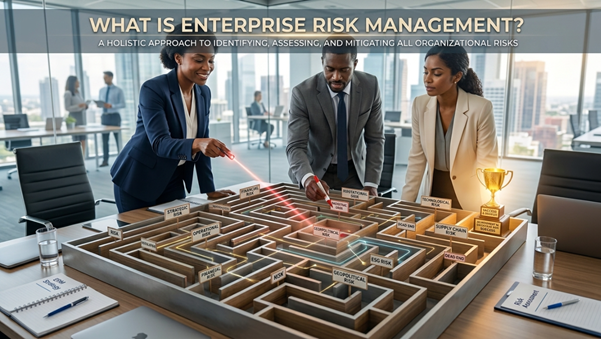
Enterprise Risk Management is a structured, organization-wide approach to identifying, assessing, managing, and monitoring risks that could affect an organization's ability to achieve its objectives. Unlike traditional risk management that usually operates in silos (IT handles cybersecurity, finance handles credit, operations handles business continuity) - ERM connects these views into a single, enterprise-wide picture.
The two most widely referenced frameworks are COSO ERM (updated in 2017) and ISO 31000. COSO emphasizes the integration of risk with strategy and performance. ISO 31000 provides principles and guidelines applicable across industries and geographies. Both frameworks agree on one fundamental point: risk management is not a standalone function. It is a lens through which every strategic decision should be evaluated.
But here’s where most organizations get stuck: they confuse having a risk register with having an ERM program. A risk register is a document. ERM is a capability. The register records what has been identified. The capability ensures that identification is continuous, that assessment is quantified, and that the output drives actual decisions and not just quarterly reports that leadership skims and files.
Why ERM Matters More Than Ever

The risk environment is accelerating exponentially. Consider the data:
According to a 2025 Business Risk Survey, 80% of ERM decision-makers say volatility is either increasing or holding at elevated levels. Nearly three out of four organizations say the number of discrete, critical risks their organizations face has grown in the past 24 months.
Meanwhile, 57% of respondents to International SOS's Risk Outlook 2026 survey said new risks are emerging faster than their organizations can address them. And 74% of executives surveyed by BDO said embedding risk thinking into business culture is now a top organizational priority.
Five forces are driving this urgency:
- Regulatory convergence
- Cloud and digital transformation
- Third-party risk
- Board-level accountability
- Demand for quantified risk insights
From Nigeria's NDPA to South Africa's POPIA, from Ghana's CISD to Europe's DORA, regulators have moved from issuing guidelines to issuing mandates with increased enforcement. However, at the same time, 63% of CEOs and managing directors noted that regulatory risk is one of the top risks they feel unprepared for.
As organizations migrate their infrastructure to multi-cloud environments like AWS and Azure, the attack surface expands and traditional perimeter-based controls lose relevance.
43% of enterprise risk managers reported that cyber attacks and data breaches were the most common third-party risk event in the past year.
Directors now rate organizational risk levels at 6.8 out of 10, and 65% believe significant changes are needed in their approach to crisis management.
Boards and CFOs are no longer accepting red/amber/green heat maps. They want financial exposure in currency including annualized loss expectancy, breach probability, non-compliance cost. Qualitative language is losing credibility at the executive level.
Key Benefits of Enterprise Risk Management

These are some of the outcomes a mature ERM programme delivers:
Better visibility across the business
ERM connects risk data from every function (security, compliance, operations, & finance) into a unified view. This eliminates the scenario where four executives give the board four different answers to the same question.
Faster, more informed decisions
When risk is quantified and current, decision-makers can assess trade-offs in real time rather than waiting for a quarterly review cycle that delivers stale data.
Improved organizational resilience
Organizations with mature ERM programmes detect disruptions earlier, respond faster, and recover more predictably because they have already modelled the scenarios and tested the responses.
Reduced operational duplication
In multi-framework environments (ISO 27001, PCI-DSS, SOC 2, NDPA), overlapping controls are often assessed and evidenced separately. ERM-driven cross-mapping reduces this duplication significantly, in some cases by up to 60%.
Stronger stakeholder confidence
Regulators, investors, customers, and partners increasingly expect organizations to demonstrate (not just claim) that risk is being managed. A functioning ERM programme provides the evidence base for that demonstration.
Earlier risk detection
Continuous monitoring surfaces changes in risk posture as they happen in real time. 80% of risk professionals agreed with this, sharing that faster risk detection would give them a competitive advantage.
Seven ERM Strategies That Work for Any Sector

The benefits of implementing a strong ERM programme include:
1. Align risk with business objectives. Risk does not exist in a vacuum. Every risk should be evaluated in terms of its impact on a specific strategic objective: revenue growth, market expansion, regulatory standing, and operational efficiency. If a risk cannot be connected to an objective, it either does not belong in the programme or the objective has not been defined clearly enough.
2. Define risk appetite clearly. A risk appetite statement endorsed by the board is the foundation of every ERM decision. Without it, teams default to avoiding all risk — which is neither realistic nor strategically sound. Risk appetite should be specific, measurable, and referenced in every risk acceptance or treatment decision.
3. Quantify risk where possible. Move beyond qualitative heat maps. Frameworks like FAIR (Factor Analysis of Information Risk) allow organizations to calculate annualized loss expectancy, breach probability, and financial exposure using real operational data. Quantification converts risk from a conversation into a calculation — which is the only language the CFO and the board are equipped to act on.
4. Break down organizational silos. ERM fails when security, risk, compliance, and audit operate as independent functions with independent data. The goal is a single control environment where one control, assessed once, satisfies obligations across every relevant framework. This is where the operational savings materialize — and where blind spots between functions get eliminated.
5. Move to continuous monitoring. Annual or quarterly risk assessments produce a snapshot that is outdated the moment it is completed. Continuous monitoring ensures that risk posture reflects the current state of the organization — not the state it was in at the last review. Only 6% of organizations currently use AI to assist in identifying risks (IIA, 2025), which means the gap between continuous and periodic programmes is still wide — and the advantage of closing it is still available.
6. Translate risk into business language. If the risk team's output cannot be understood by the CEO without a glossary, the programme has a communication problem. Risk reporting should speak in terms of financial exposure, probability, and strategic impact — not technical severity ratings that stay inside the security function.
7. Orchestrate all six strategies on a unified platform. Platforms like Cybervergent are built to operationalise the strategies above as a single, continuous workflow rather than in separate initiatives. Controls assessed once apply across every framework they satisfy. Risk quantification, continuous monitoring, and business-language reporting become the norm. The programme stops being a collection of strategies the team aspires to and becomes the way the organisation actually operates.
Common ERM Mistakes to Avoid

Treating ERM as a compliance exercise.
If the programme exists to satisfy a regulatory requirement and nothing else, it will produce documentation, not insight. Compliance is a byproduct of good ERM, not the purpose of it.
Relying only on qualitative assessments.
"High/medium/low" tells leadership that a risk exists. It does not tell them how much it will cost, how likely it is, or what the return on mitigation would be. Qualitative-only programmes lose executive credibility over time.
Maintaining risk registers nobody uses.
A risk register that is updated quarterly and reviewed by no one is overhead, not management. If the register does not drive decisions, it is a file - not a programme.
Running siloed risk programmes.
When security, compliance, and operational risk are managed independently, the gaps between them become the organization's biggest vulnerability. The risks that matter most are often the ones that live between functions, not inside them.
Waiting for incidents before acting.
Reactive risk management is expensive. By the time an incident forces action, the cost of remediation is always higher than the cost of prevention. ERM's entire value proposition is in acting before the incident — not after.
Conclusion
As risk environments become more complex (and they will), the gap between organizations that manage risk continuously and those that manage it periodically will widen. The data already shows it. Organizations already investing in integrated, quantified, technology-enabled ERM are making faster decisions, spending less on compliance duplication, and building the kind of stakeholder confidence that periodic programmes simply cannot produce.
The question is no longer whether your organization needs ERM. It is whether the ERM you have is the ERM the next five years require.
Cybervergent is a Digital Trust platform that unifies compliance, risk, data security, and governance into a single enterprise posture. To see what Integrated Enterprise Posture looks like for your organization, visit cybervergent.com/demo.